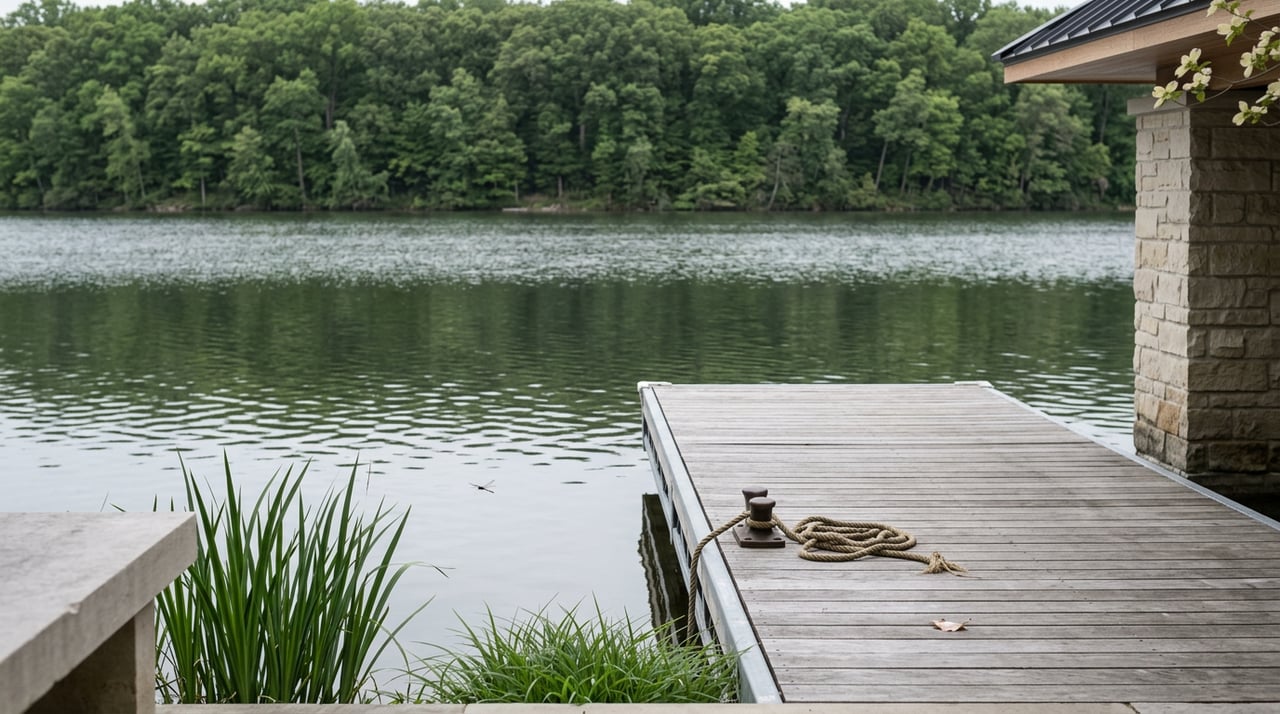
Selling a Lakefront Home in Hendersonville TN? Check Dock Permits
July 16, 2026
July 16, 2026
The Hendersonville market has quietly split in two this year. Non-lakefront homes are sitting longer, with more room for buyers to negotiate than the city has offered in several years. Properly permitted lakefront still moves quickly when priced right. That gap is the whole story, and the paperwork tucked in a manila folder in your kitchen drawer is what decides which side of it your listing lands on.
If you own a home on Old Hickory Lake and you are thinking about selling in 2026, the most important asset on your property is not the dock. It is the permit file for the dock. Sellers who understand that early keep their leverage. Sellers who assume the permit rides along with the deed find out otherwise around day fourteen of the buyer's due diligence period, usually by phone, usually on a Friday.
Here is the mechanic that almost no first-time lakefront seller has priced into their timeline. A dock permit is tied to the property owner, not the property. When ownership changes, the permit does not automatically follow. Permits do not automatically transfer with property ownership, and the new owner is required to apply for a Section 26a permit within 60 days of closing on the property.
That single rule creates three distinct problems for sellers.
The first is a compliance problem. If the dock on the water today does not match the dock on the approved plan, the buyer's new permit application will surface the discrepancy. Only docks that are in compliance with the previous permit qualify for a transfer, the dock must be built exactly as previously approved, and if you are proposing to make any changes to a previously permitted dock, a new permit is needed prior to any modifications. A prior owner who added a swim ladder, replaced decking with a wider footprint, or built up a second-story cover has quietly turned a clean transfer into an enforcement conversation.
The second is a structural problem specific to second stories. Second stories on docks can be constructed as an open deck with railing, but they cannot be covered with a roof or enclosed with siding or screening, and if the second story of a dock is covered, it will likely have to be removed. A covered upper deck is one of the single most common re-trade triggers on Old Hickory. It looks like an amenity in listing photos and reads like a demolition line item in an inspection report.
The third is a land-rights problem. The federal government owns land or land rights, such as a right to flood the land or prevent certain construction, along most reservoir shoreline. If a prior owner cleared vegetation, added a fire pit, ran electrical, or built a set of steps on federal ground without approval, that work belongs to the seller to resolve before closing, not to the buyer to inherit after.
There is a persistent local confusion worth resolving in your own head before a buyer's agent asks. Old Hickory Lake is a Cumberland River reservoir managed by the U.S. Army Corps of Engineers, not the Tennessee Valley Authority. The TVA framework governs a different set of Middle Tennessee lakes and gets cited by analogy on Old Hickory listings because the two agencies operate similar Section 26a permitting logic. The practical rules a Hendersonville seller cares about, dock size limits, transfer requirements, and shoreline alteration approval, look almost identical. The jurisdiction on your specific parcel does not. Getting that right on day one prevents a week of chasing the wrong phone number.
The Corps held a shoreline management town hall in Hendersonville in February 2026 that covered permit changes and enforcement priorities for Old Hickory homeowners. If you have not read the recap or spoken to a neighbor who attended, that is your starting homework.
Buyers arriving from out of state read "lake home" as one category. Sellers who let that assumption stand leave money on the table or draw offers from buyers who then discover the tier mismatch during inspections. Middle Tennessee lake listings sort into four honest categories, and pricing confidence follows the category.
Lakefront with a private, permitted dock. As of spring 2026, modest older lakefront in Hendersonville has been starting around $700,000, with updated or new-build waterfront estates climbing past $1.5M. Inventory is genuinely limited because the shoreline is finite.
Lake-access with a shared dock, boat ramp, or community waterfront. These sell like standard Hendersonville family homes carrying a ten to twenty percent premium, typically landing in the $450,000 to $700,000 band as of Q2 2026. There is no private permit conversation, which is a feature, not a bug, from a transaction standpoint.
Lake-view without direct or community access. A five to ten percent premium over comparable non-lake homes. The view is the product.
Non-lake Hendersonville. Priced on its own merits. This is the segment where extended days on market and growing inventory have opened real negotiating room for buyers.
If your listing sits in the first category, the permit file is the pricing anchor. If it sits in the second, HOA documentation on the community dock and ramp is the equivalent artifact. Do not conflate the two in marketing copy.
Sequence matters here more than it does on a standard interior turn. A cosmetic refresh is worthless if the dock file is broken. Work from the water back to the house.
Deals fall apart in specific places, not everywhere at once. On Old Hickory, the recurring pressure points are these:
Neighborhoods where these come up regularly include the Indian Lake Peninsula, Walton Ferry, Sanders Ferry, Cherokee Woods, and Blue Ridge, along with older lots near Drakes Creek Marina, Anchor High Marina, and Creekwood Marina. Newer developments closer to Durham Farms and Mansker Farms carry a different profile, usually lake-access rather than lakefront, and the friction shifts from Corps paperwork to HOA documentation.
How long does a Transfer of Ownership actually take? Plan for four to eight weeks from a clean application, longer if the dock has unpermitted modifications or if the parcel's land rights need clarification. Build that window into your closing timeline before you accept an offer, not after.
Can I sell without transferring the permit? You can close on the real estate. The buyer then has 60 days to apply for their own permit under the current framework. What you cannot do is guarantee the buyer will receive one, which is why buyers' agents in 2026 are increasingly asking for permit verification as a contingency before offer, not after.
Does replacing the dock before listing help or hurt? It depends on whether the existing permit already covers what you would build. Replacing under an approved footprint is usually straightforward. Replacing with any change in size, coverage, or configuration restarts the permitting clock and can push your listing out of the spring window entirely.
Selling a lake home on Old Hickory is a paperwork transaction wrapped in a lifestyle photograph. If you are thinking about a 2026 or 2027 listing and want a clear-eyed walk through your permit file, your price tier, and a pre-listing sequence built around Hendersonville's actual market split, Tricia Gray would be glad to sit down with you. Let's Connect.
Stay up to date on the latest real estate trends.




Tricia is known for her patient approach and understands that finding the perfect property may take some time. Above all, she wants to ensure her clients are happy. Let's connect today!